Ephesus Ancient City: The Port That Lost Its Sea
Ephesus ancient city, Roman capital of Asia: the Library of Celsus, the Great Theatre, the Terrace Houses and the silt that choked its harbour.
The ancient city of Ephesus lies in İzmir province, about 3 km southwest of Selçuk, on a slope that once opened onto the sea but now looks out over a plain. In the Roman period it was the capital of the province of Asia; structures such as the Library of Celsus, the Great Theatre, the Temple of Hadrian and the Terrace Houses can still be seen today. In 2015 it was inscribed on the UNESCO World Heritage List.
The story of Ephesus lies not only in its buildings but in the movement of water: the city's wealth came from its harbour, and its end came when that harbour silted up. An engineering mistake described by Strabo is the most striking scene in this process; the riot caused by Paul's preaching in the city also shows how closely the city's livelihood was bound up with Artemis.
At a glance
- Location: Selçuk, İzmir; about 3 km southwest of Selçuk.
- Foundation: Founded in the 10th century BC by Greek colonists from Attica and Ionia; it is associated with the settlement that appears as Apasa in Hittite sources. Its legendary founder is the Athenian prince Androcles.
- Roman period: Under Roman control from 129 BC; in the time of Augustus, the capital of the province of Asia.
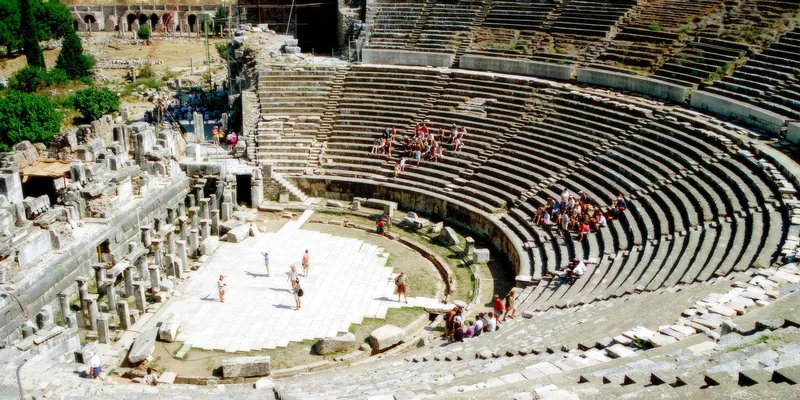
- Great Theatre: Sources give a capacity of 24,000–25,000.
- Excavations: John Turtle Wood began in 1863; Otto Benndorf continued in 1895.
- UNESCO: Inscribed on the World Heritage List in 2015 (criteria iii, iv and vi).
History
Foundation and relocation
Ephesus was founded in the 10th century BC by Greek colonists from Attica and Ionia; it is suggested that it is the same place as Apasa, which appears in Hittite sources as the capital of Arzawa. There has been settlement in the area since the Neolithic, from about 6000 BC. According to legend, Androcles chose the spot indicated by the Delphic oracle and shown by a fish and a wild boar. Ephesus was one of the twelve Ionian cities.
Lysimachus, a successor of Alexander, moved the city from the old settlement around the Temple of Artemis to its present site, about 2 km away. Strabo's account (14.1.21) is striking: Lysimachus built a wall around the present city, but the people did not want to move; Lysimachus blocked the sewers and flooded the city, and the people moved "gladly". The city was refounded about 300 BC on the grid plan of Hippodamus of Miletus. Wikipedia says that Lysimachus ruled Ephesus from 290 BC and that in 292 BC he settled the people of Lebedos and Colophon there; the two dates do not quite match.
Capital of Roman Asia
Ephesus came under Roman control in 129 BC, when the Kingdom of Pergamon passed to Rome. Augustus made the city, rather than Pergamon, the capital of the province of Asia under a proconsul (27 BC). Strabo (14.1.24) describes Ephesus as "the greatest emporium in Asia this side of the Taurus". Estimates of the city's population differ widely: values range from 33,600–56,000 (Hanson) to 225,000 (Broughton); the 2017 model of Hanson and Ortman gives 71,587. The city had at least six aqueducts and several large bath complexes.
How the harbour closed
Strabo (14.1.24) writes that the city had both a dockyard and a harbour, and then describes how the harbour entrance was narrowed by engineers. King Attalus II Philadelphus, thinking that the harbour mouth was too wide and that a mole built there would deepen the harbour, ordered the mole to be built. According to Strabo, both the engineers and the king foresaw the result wrongly: the silt trapped inside by the mole made the whole harbour shallow up to the mouth. Before that, the tide had carried the silt out to sea.
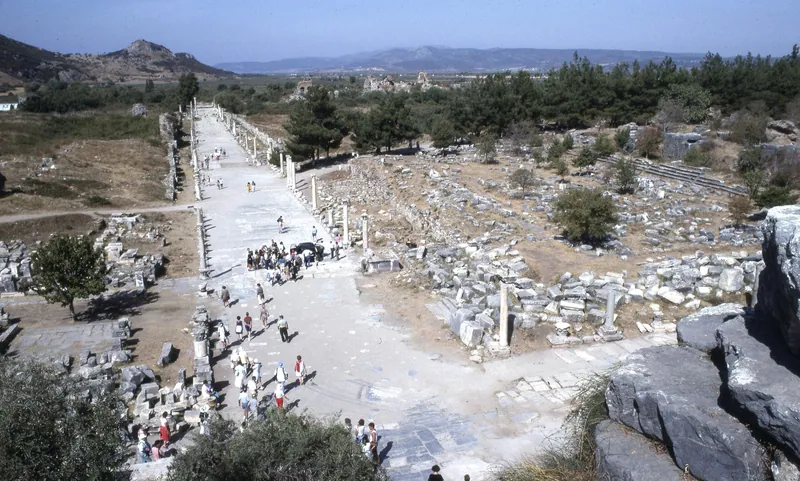
At the root of the problem is the river. The silt of the Küçük Menderes (ancient Kaystros) closed the old harbour and brought malaria; the 2007 study by Kraft and colleagues in the journal Geoarchaeology notes that the conditions of the harbours of Ephesus and the Artemision changed over the last three thousand years with the advance of the Kaystros delta. Today the coast is 3–4 km from the city, and in another part the harbour is 5 km inland; the distance varies with the source.
Paul and the silversmiths
Paul lived in Ephesus for three years, AD 52–54. According to Acts 19:23–41, the silversmith Demetrius gathered the tradesmen who made miniature shrines of Artemis: Paul's preaching threatened both the temple and their livelihood. The crowd shouted for about two hours, "Great is Artemis of the Ephesians!"; it seized two of Paul's companions and dragged them into the theatre. In the end the town clerk calmed the crowd: if there was a complaint, it should go to the courts or the legal assembly; otherwise the city risked a charge of rioting.
Christian Ephesus, the last centuries
In 431 the Third Ecumenical Council (the First Council of Ephesus) met in the Church of Mary and condemned Nestorius. The Basilica of St John was built in the 6th century under Justinian I. The Goths destroyed the city in 263 (the Wikipedia articles on Ephesus give this year; sources give dates between 262 and 268 for the Gothic raid into the Aegean, see the Temple of Artemis). Later, in the 4th century, the emperor Constantine the Great rebuilt a large part of the city. In 614 an earthquake and the Sasanian War caused damage; there were Arab raids in 654–655, 700 and 716, and an attack in 781. The Turkish conquest came in 1304 (Sasa Bey), and by the 15th century Ephesus had been abandoned.
Excavations
John Turtle Wood began excavating with the support of the British Museum in 1863; the work stopped in 1874. Otto Benndorf restarted the excavation in 1895 and founded the Austrian Archaeological Institute in 1898. Turkey halted the excavations in October 2016 and allowed them again in May 2018.
What to see
The Library of Celsus
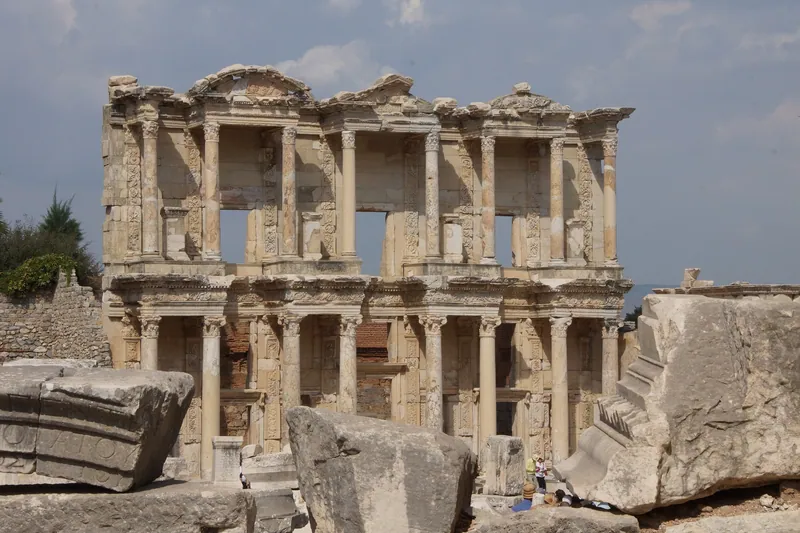
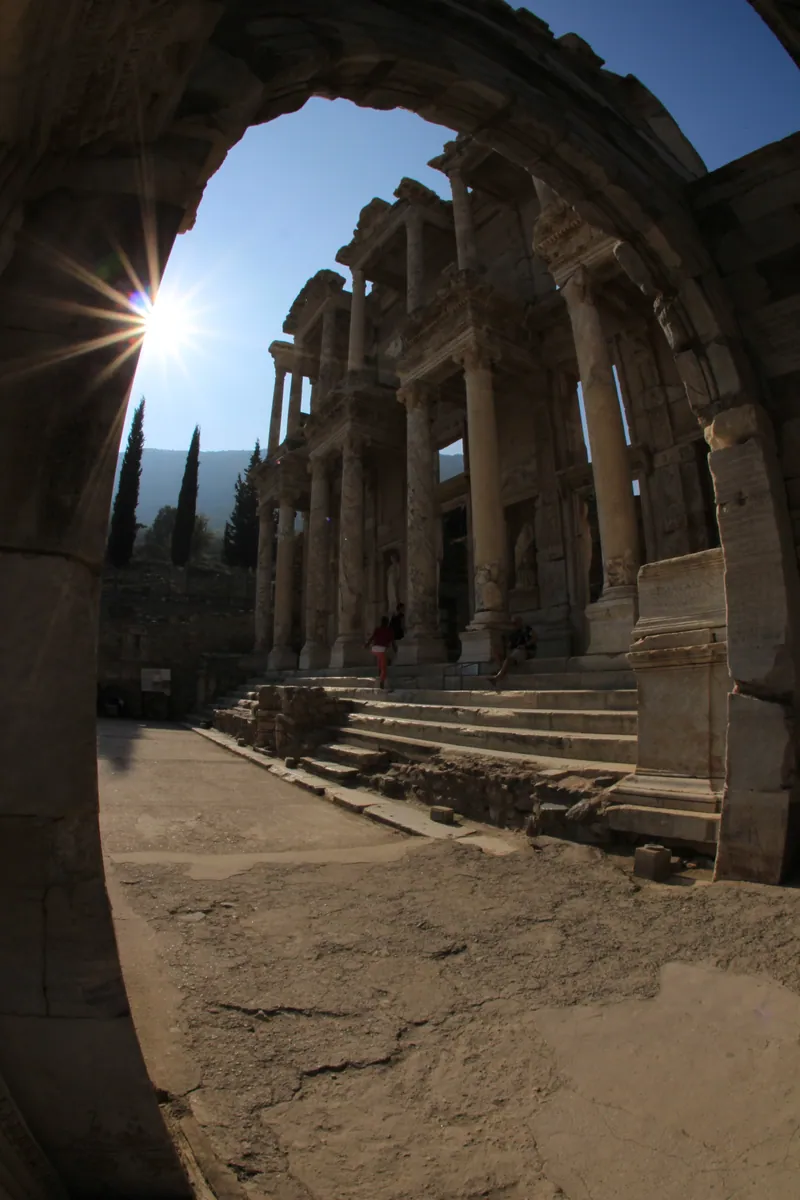
The best-known building in the city. Tiberius Iulius Aquila Polemaeanus had it built in memory of his father Celsus Polemaeanus in the 110s AD; the building was completed under Hadrian after Aquila's death. Celsus had been elected consul in AD 92 and had been proconsul of Asia; he lies in a marble sarcophagus in a burial chamber beneath the library. An inscription records that Celsus left 25,000 denarii for reading material. The library is thought to have held about 12,000 scrolls.
A fire in AD 262 destroyed the interior and its contents; whether it came from an earthquake or a Gothic invasion is uncertain. An earthquake in the 10th or 11th century brought down the façade. Austrian archaeologists excavated the pieces in 1903–1904; in work directed by Volker Michael Strocka the façade was re-erected in 1970–1978. Only the façade was rebuilt; missing parts were replaced with copies or left blank. The statues of Sophia, Episteme, Ennoia and Arete in the niches of the façade are not original; they have been replaced by other female statues.
The Great Theatre
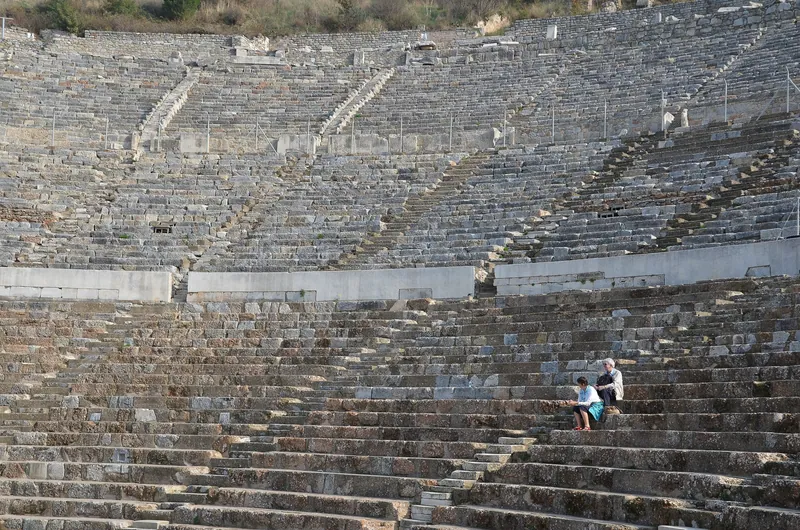
On capacity the sources are not consistent: both the Turkish and the English Wikipedia use the values 24,000 and 25,000 together within themselves. The theatre is tied to the Paul episode through Acts 19: according to the text, the crowd dragged two of Paul's companions "into the theatre".
The Temple of Hadrian
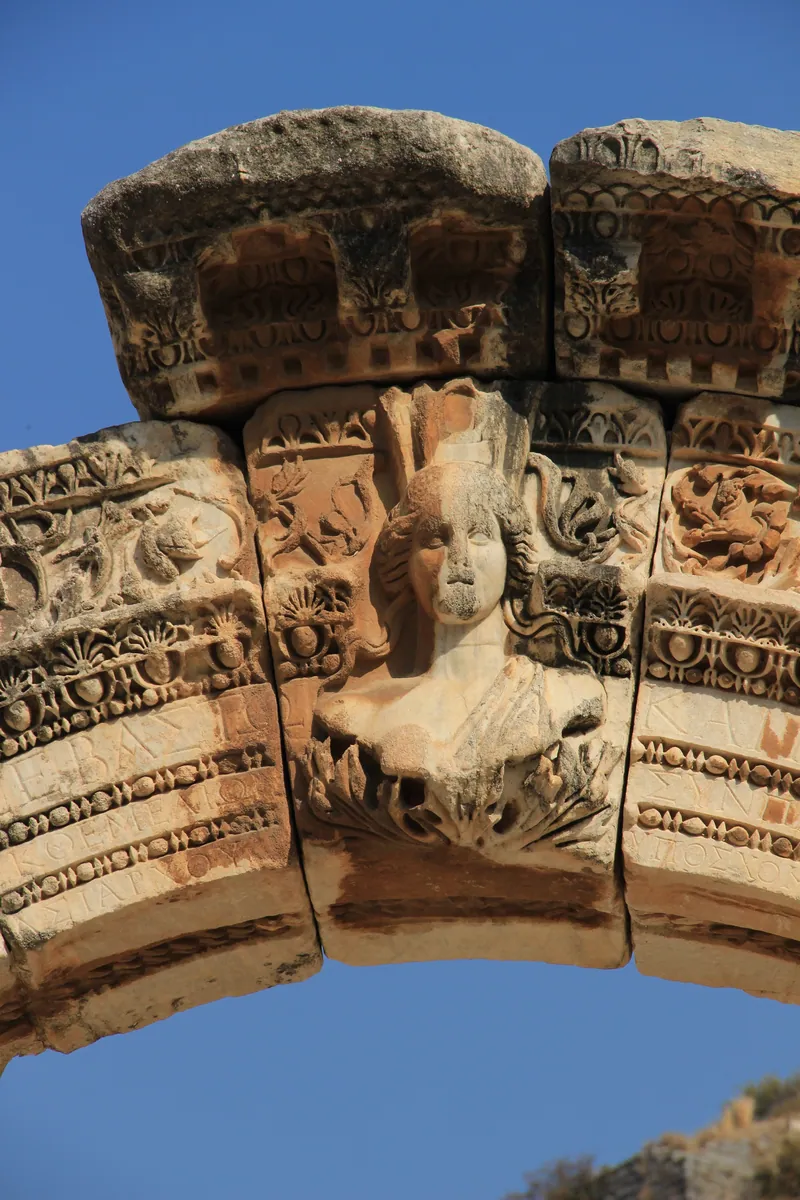
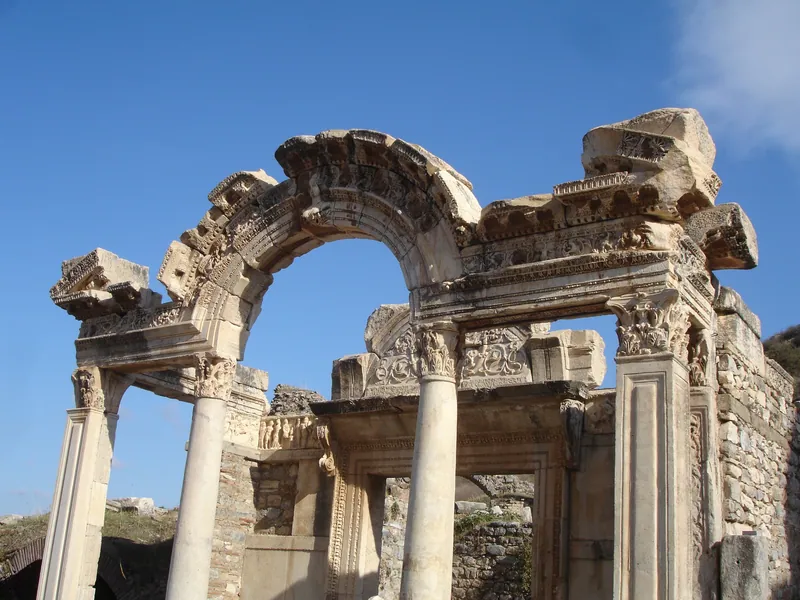
The temple is dated to the 2nd century and was repaired in the 4th century. The keystone of its arch has a relief of a female head.
Curetes Street and the Terrace Houses
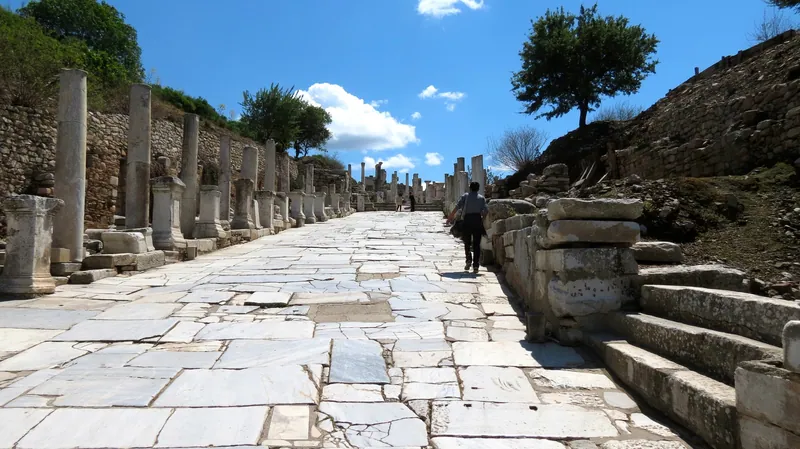
The photographs show the marble columns and mosaic pavement of Curetes Street. The Terrace Houses consist of two insulae built on a steep slope and lie next to the Library of Celsus. Terrace House 2, the larger insula, consists of six separate dwellings on three terraces and covers about 4,000 m²; most of the houses had running water, fountains and a hypocaust (underfloor heating). The reception rooms had marble cladding, marble and mosaic floors and wall paintings; the 178 m² dining hall of dwelling unit 6 (the Marble Hall) had been decorated at the start of Hadrian's reign and was under repair at the time of the AD 262 earthquake: slabs waiting to be fitted were found leaning against a wall, under the collapse layer. About 90 percent of the hall's slabs are preserved, but there are about 120,000 pieces and most are the same colour.
The sources differ on the history of the Terrace Houses. World Archaeology writes that the houses came to an early end with the earthquake and fire of AD 262; according to the article in Cornucopia, Terrace House 2 was abandoned at the end of the 3rd century (it had earlier been thought to be inhabited until the 7th century), while Terrace House 1 was lived in until the end of the 7th century. Excavations were carried out in 1960–1985 (World Archaeology) or 1967–1983 (Cornucopia); a protective roof was put over Terrace House 2 in 1999.
On the route
Ephesus is the fifth story on the Aegean Coast route. The previous stop is the Temple of Artemis and the next is the House of the Virgin Mary. The route also includes Pigeon Island, Priene, Miletus and Didyma.
Frequently asked questions
Why did the harbour of Ephesus close?
Because of the silt carried by the Kaystros (the Küçük Menderes). Strabo writes that the mole built on the orders of Attalus II narrowed the harbour mouth, kept the silt inside and made the harbour even shallower. The study by Kraft and colleagues shows that the delta advanced over the last three thousand years.
Who built the Library of Celsus?
Tiberius Iulius Aquila Polemaeanus, in memory of his father Celsus Polemaeanus, in the 110s AD; it was completed after Aquila's death, under Hadrian.
What did Paul do in Ephesus?
He stayed for three years, AD 52–54. Acts 19 tells how, under the leadership of the silversmith Demetrius, the tradesmen gathered a crowd against Paul's preaching and filled the theatre with it.
Is Ephesus on the UNESCO list?
Yes, it was inscribed on the World Heritage List in 2015 (criteria: iii, iv and vi).
When were excavations carried out at Ephesus?
John Turtle Wood began in 1863, and Otto Benndorf continued in 1895 and founded the Austrian Archaeological Institute. The excavations stopped in 2016 and were allowed again in 2018.
Sources
- Wikipedia (English): Ephesus
- Wikipedia (Turkish): Efes
- Wikipedia: Library of Celsus
- Strabo, Geography 14.1.21 and 14.1.24 (Thayer, University of Chicago)
- Acts of the Apostles 19:23–41 (Bible Gateway)
- Kraft et al., The geographies of ancient Ephesus and the Artemision in Anatolia, Geoarchaeology 22(1), 2007
- World Archaeology: Ephesus, Terrace Houses
- Cornucopia: At home with the Ephesians