Didyma Temple of Apollo: The Unfinished Oracle
Didyma Temple of Apollo in Didim: the Branchidai oracle, the Persian destruction of 494 BC, 600 years of building and construction drawings in the walls.
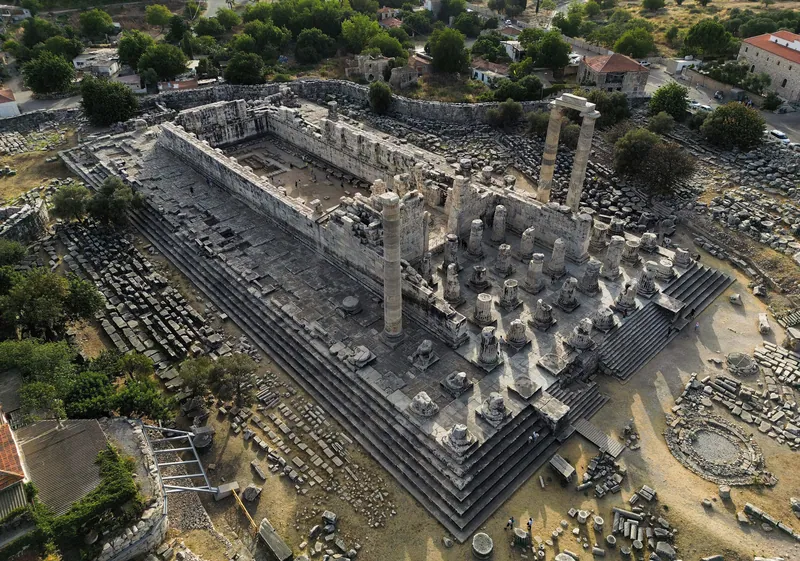
The Temple of Apollo at Didyma stands in the Didim district of Aydın, at the centre of the largest sanctuary of ancient Miletus. Didyma was not a city but an oracle; Encyclopaedia Romana ranks its famous oracle second only to Delphi. Today the temple's surviving columns and the vaulted passages descending to the inner courtyard bear the mark of a building that went on for centuries and was never finished.
What makes the temple unusual is that its unfinished state allows it to be read like a "building ledger". Lines noticed on the walls in 1979 show that the ancient architects drew their sketches on the stone of the building itself.
At a glance
- Location: Didim, Aydın. About 16 km from Miletus in a straight line; the Sacred Way is about 20 km.
- Name: In Greek "didyma" means twins; the name may also be of Carian origin.
- Prophetic lineage: The Branchidai priestly family; the oracle was given by a priestess who sat above the sacred spring.
- Break: In 494 BC the Persians burned the sanctuary after Lade.
- New temple: Begun after 334 BC, its main body finished about 100 BC, but it was never completed.
- Columns: Each about 19.70 m; 10 on the short side and 21 on the long side.
- Discovery: In 1979 Lothar Haselberger found construction drawings on the inner walls.
History
The sanctuary and the Branchidai
The archaeological evidence for the sanctuary goes back to the late 8th or early 7th century BC; a building a hundred feet long (a hekatompedos) from about 700 BC is known. The late Archaic temple of the mid-6th century BC had a double row of columns (dipteros). The site was run by the Branchidai priestly family, which traced its origin to Branchus, the lover of Apollo. A priestess sitting above the sacred spring spoke words, and the Branchidai interpreted them. Encyclopaedia Romana writes that there is uncertainty about how the messages were conveyed, perhaps from the antechamber or through the passages leading to the adyton.
The Sacred Way between Miletus and Didyma was built in the 6th century BC for festival processions; along it stood statues of nobles, animals and mythical creatures. Some of these are in the British Museum; Charles Thomas Newton excavated them. Trajan renewed the road in AD 101. The sanctuary's harbour, Panormos (today Mavişehir), lay about 3 km northwest of the temple.
494 BC: the Persians and the silent oracle
After the naval battle of Lade the Persians burned the sanctuary in 494 BC. They took Apollo's bronze cult statue to Ecbatana; the oracular spring stopped flowing. Callisthenes reported that the spring flowed again in 331 BC, when Alexander was passing through Egypt. Seleucus I brought the cult statue back from Persia about 300 BC; Encyclopaedia Romana writes that the statue returned in 301. The same source also reports an account that the Branchidai betrayed the sanctuary and that their descendants were massacred by Alexander; this is an account, and should not be read as a documented event.
The new temple: a 600-year building site
The building of the new temple began after Alexander freed Miletus (334 BC). Vitruvius gives the architects as Paionios of Ephesus and Daphnis of Miletus. The main body was largely finished about 100 BC; the building took more than 600 years and the temple was never finished. Its pediments remained incomplete. The columns of the east façade were added in the time of Hadrian. Suetonius writes that Caligula considered finishing the temple; according to Pausanias the temple was still unfinished about five centuries later (Encyclopaedia Romana).
The building had a double row of Ionic columns. The columns are 19.70 m high; there are 10 columns on the short sides and 21 on the long sides, but not all of them were erected before the end of antiquity. The platform (krepidoma) is about 60 × 120 m, the stylobate 51 × 109 m. The doorway is about 14 m high; its threshold is about 1.5 m above the floor of the antechamber. The walls of the sekos (inner courtyard) are about 25 m. Encyclopaedia Romana gives the planned number of columns as 120 and the height of the columns as more than 64 feet and "the tallest of Greek temples"; it adds that each column cost about 40,000 drachmas and that a worker earned about two drachmas a day. In the visible parts, marbles from Miletus, Thasos, Heraclea and Proconnesus were used; in the hidden foundation and wall cores there are more than 12,200 m³ (about 33,000 tonnes) of limestone.
The ranking of the temple's size varies with the source. Wikipedia says it was the largest of the Greek world after the Temple of Hera on Samos and the Temple of Artemis at Ephesus, that is, the third; Encyclopaedia Romana says fourth, after the Temple of Artemis, the Heraion of Samos and the Olympieion in Sicily.
The Roman age and the end
The Galatians plundered the sanctuary in 277/276 BC and pirates in 67 BC; Pompey permitted the Didymeia again in 63 BC. Hadrian came in 129 and became "Prophet" (the sanctuary's highest office). The oracle ended when Theodosius I closed the pagan temples; Encyclopaedia Romana mentions an edict sent to Cynegius in AD 385. About AD 500 a church was built inside the sekos (it was demolished in 1925). The earthquake of 1493 brought the temple down; the village was abandoned, and people who settled later used the ruins as a quarry. According to Encyclopaedia Romana three columns remained standing after the earthquake; a photograph caption in the Turkish Wikipedia, on the other hand, speaks of two intact Ionic columns.
The drawings in the walls
In 1979 Lothar Haselberger found lines incised in the unpolished inner walls of the sekos; among them are a column sketch and a pediment design. Encyclopaedia Romana writes that the fine lines are full-scale construction drawings that guided the building, and that they survive because the walls were never polished. Another page of the same source says that one of the lines gives the geometric scheme of a column base, and that the lines are almost invisible unless photographed and the image enhanced. Some of the lines show the way of laying out the slight swelling of the column (entasis), as a probable example of the drawings Vitruvius described but which are lost.
Haselberger and other scholars thought that the drawing of a small temple's pediment on the west wall might be the design of Apollo's naiskos; but the drawn pediment was more than 2 metres wider than the actual pediment of the naiskos. This puzzle was solved in 2012: the drawing was the design of the Hellenistic Temple of Artemis at Didyma. The foundations of this Temple of Artemis were found in 2013, about 100 m north of the Temple of Apollo; they were reburied after excavation, so nothing is visible today.
The history of excavation
Ciriaco de' Pizzicolli visited in 1446, the English in 1673; the Society of Dilettanti sent expeditions in 1764 (Richard Chandler) and in 1812 (William Gell). Pontremoli and Haussoullier excavated in 1895; German excavations continued in 1905–1913 and the German Archaeological Institute resumed in 1962. The theatre was found in 2010–2011.
What to see
Columns and bases
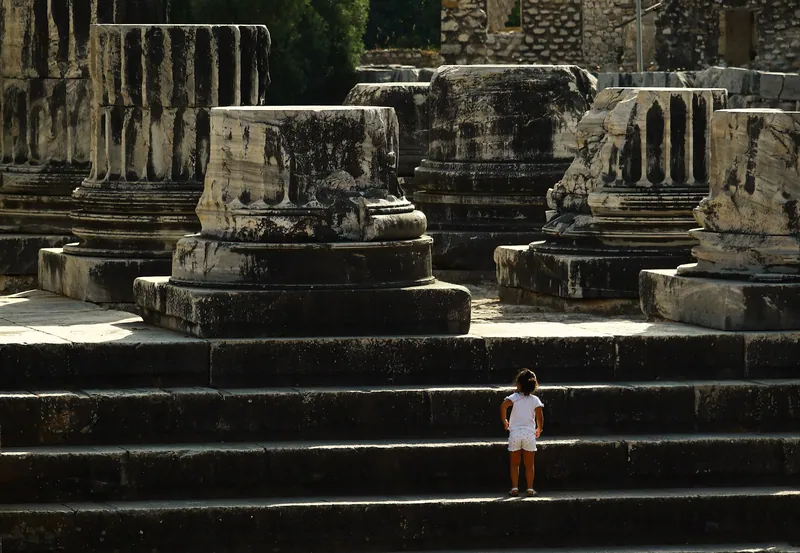
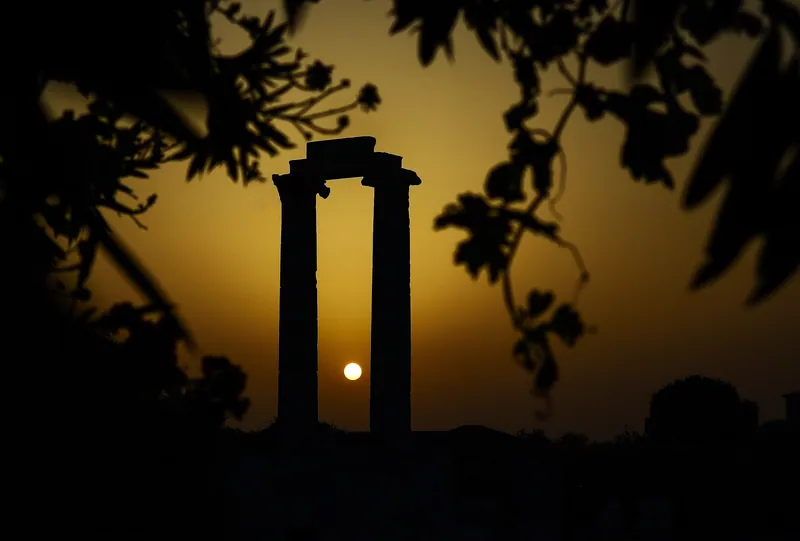
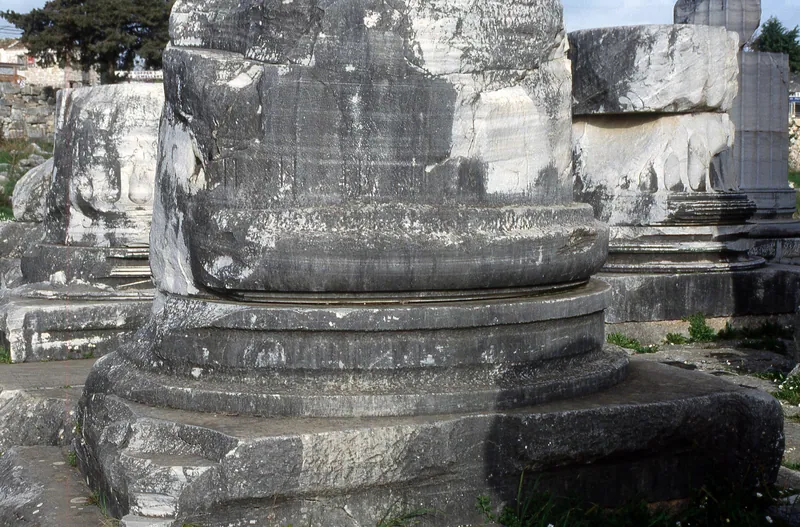
The emblem of the site is the column bases and the standing columns; the column shafts and bases give a sense of the colossal scale.
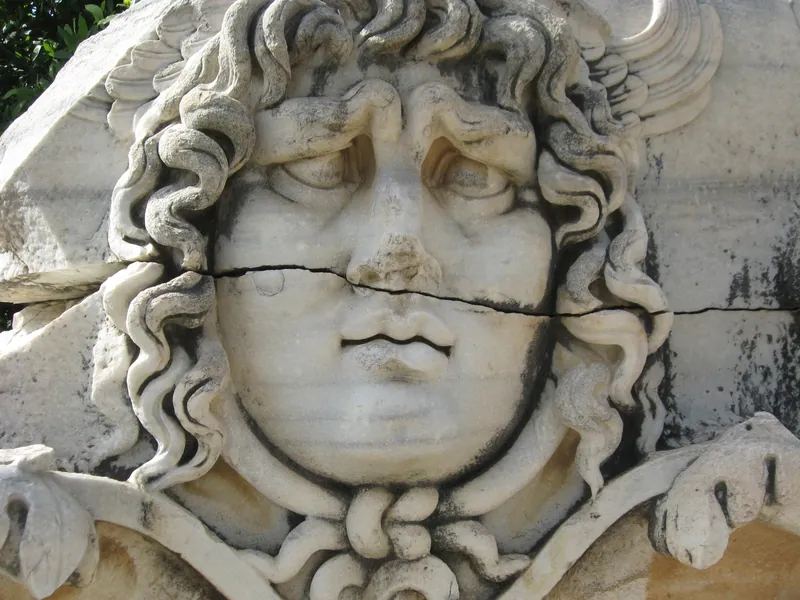
The Medusa head and the decoration
Monumental Medusa heads stand out on the temple's frieze.
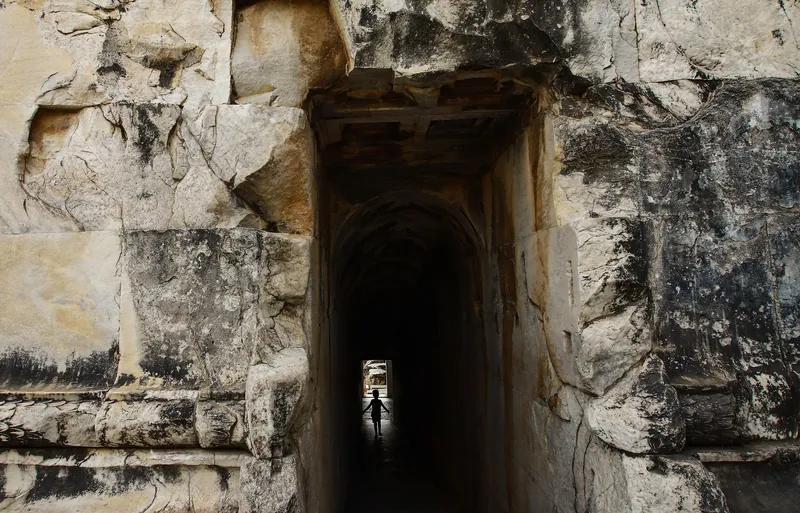
The vaulted passage
From the antechamber two long, narrow, sloping tunnels, made within the thickness of the wall, descend to the inner courtyard. In the inner courtyard stood the oracular spring, the sacred laurel and the naiskos.
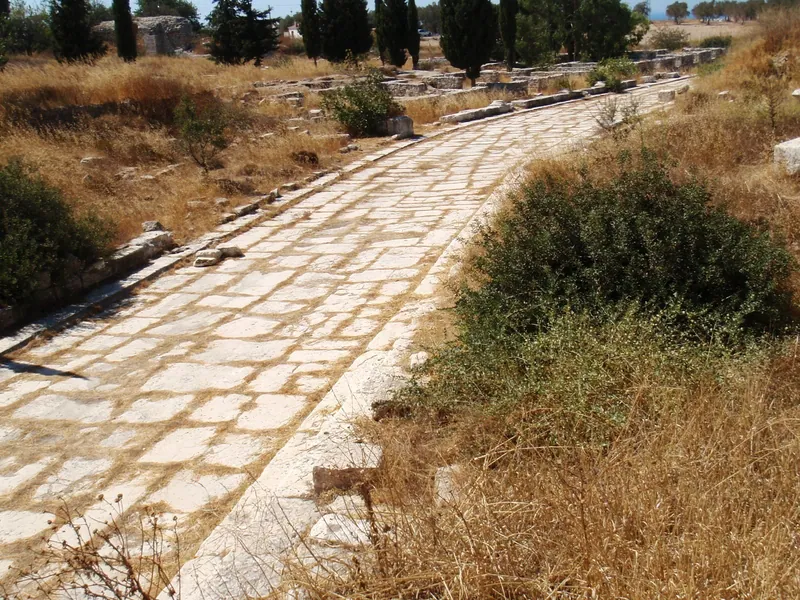
The Sacred Way
A paved section of the Sacred Way can still be seen today.
On the route
Didyma is the last stop on the Aegean Coast route. The previous stop is Miletus; in history the Sacred Way linked the two. The start of the route, towards İzmir, is Metropolis and Belevi, and its middle is around Ephesus and the Temple of Artemis.
Frequently asked questions
How was the oracle given at Didyma?
A priestess sitting above the sacred spring spoke the words, and the Branchidai priestly family interpreted them. Encyclopaedia Romana writes that there is uncertainty about exactly how the messages were conveyed.
Who built the temple?
According to Vitruvius, Paionios of Ephesus and Daphnis of Miletus. The building began after 334 BC and was never completed.
What happened to the statue of Apollo?
The Persians took it to Ecbatana in 494 BC; Seleucus I brought it back about 300 BC.
What are the drawings on the walls?
Construction drawings on the walls of the sekos, found by Lothar Haselberger in 1979; they survive because the walls were never polished. They are reported to include the scheme of a column base and of the slight swelling of the column (entasis).
How big is Didyma?
The sources differ: Wikipedia says third largest in the Greek world after the Temple of Hera on Samos and the Temple of Artemis at Ephesus, Encyclopaedia Romana fourth.
Sources
- Wikipedia: Didyma
- Wikipedia: Temple of Apollo (Didyma)
- Wikipedia (Turkish): Didyma
- Encyclopaedia Romana (University of Chicago): The Temple of Apollo at Didyma
- Encyclopaedia Romana: Didyma, Temple of Apollo, drawing of an Ionic base