Temple of Artemis: One of the Seven Ancient Wonders
Temple of Artemis near Ephesus: Croesus's marble temple, Herostratus's fire, Alexander's rejected offer and the single column that stands today.
The Temple of Artemis (the Artemision) stands near Ephesus, in present-day Selçuk. It was counted among the Seven Wonders of the Ancient World; in the list of Antipater of Sidon it is called "the house of Artemis rising to the clouds". Today the site has foundations, scattered architectural fragments and a single column reassembled from fragments.
The story of the building has several layers. A sanctuary renewed over the centuries grew with the contribution of the Lydian king Croesus; it was destroyed by a fire in 356 BC, rebuilt in the Hellenistic period, and came to an end in Late Antiquity. This article separates these layers on the basis of ancient authors and modern sources, and states plainly where the sources do not agree.
At a glance
- Location: Selçuk, İzmir; around Ephesus, about 75 km south of İzmir.
- Goddess: Artemis of the Ephesians, a local form of Artemis. Her wooden cult statue (xoanon) has not survived.
- Dimensions: They vary with the source and the phase. In the account based on Pliny, 127 columns, each about 18.3 m high.
- The fire: In 356 BC, on 21 July.
- Discoverer: John Turtle Wood, 1869; with the support of the British Museum, the excavation continued until 1874.
- Today: Foundations, fragments and a single column reassembled from them.
History
The early phases of the sanctuary
The cult is much older than the temple. According to a 2022 seminar abstract by Michael Kerschner of the Austrian Archaeological Institute, the sanctuary in the Early Iron Age was a small sanctuary without architecture; the main ritual was communal eating and drinking, and votive offerings were few and modest. The same abstract writes that the first stone temple was built in the second quarter of the 7th century BC, and that it is one of the earliest examples of a peripteral plan (columns all around) in the Aegean. Wikipedia, on the other hand, dates a peripteral temple with a clay floor to the second half of the 8th century BC, and reports that it was destroyed by a flood in the 7th century BC, with an ivory plaque and drops of amber coming from the debris. So the date of the first temple varies according to the sources. The re-excavations of 1987–1988 confirmed that the site had been inhabited since the Bronze Age.
According to Kerschner's abstract, after the middle of the 7th century BC the wealth of offerings clearly increased; this is linked with the investment of the Mermnad kings of neighbouring Lydia. Croesus, the last Mermnad king, contributed greatly to the first marble dipteros (a temple with a double row of columns); the abstract says that the "splendour and size" of this building established the sanctuary's fame.
Croesus's temple: building on a marsh
After conquering Ephesus between 560 and 550 BC, Croesus financed the new temple; the building began about 550 BC and took 120 years to complete. Herodotus (I.92) writes that Croesus "donated many of the columns". On the architect, ancient authors do not say the same thing: according to Strabo the first architect was Chersiphron, after whom another enlarged the building; Pliny mentions Chersiphron of Knossos; Vitruvius writes that Chersiphron and his son Metagenes began the building and Paionios of Ephesus completed it. Modern sources too write that the Cretan architect Chersiphron and his son Metagenes began the building about 550 BC.
The measurements are also disputed. Based on Pliny (Natural History 36.97), the World History Encyclopedia gives the length as 129.5 m, the width as 68.6 m, the number of columns as 127 and the height of each column as 18.3 m; compared with the Parthenon (69.5 × 30.9 m) it is almost twice as large. Wikipedia, on the other hand, gives the Croesus phase as 115 × 46 m with columns of about 13 m, and the Hellenistic phase as 137 × 69 m and 18 m high, with more than 127 columns. For the exact measurements one would need to consult the excavation publications.
Where the building was placed is also interesting. Pliny says the foundations were laid on marshy ground to reduce the effect of earthquakes, on the advice of Theodorus of Samos, and adds that layers of charcoal and sheepskins were spread under the foundation. Layers of soft mortar and charcoal were found in the excavations, but there is no trace of sheepskin. The study by Kraft, Brückner, Kayan and Engelmann published in the journal Geoarchaeology (2007) shows that the delta and floodplain of the Küçük Menderes (ancient Kaystros) changed the coastal landscape around Ephesus and the Artemision over the last three thousand years.
According to Wikipedia, the cult statue of the Croesus phase had been made by Endoios (of ebony or vine wood), and the foundation deposit held more than 1,000 finds, among them some of the earliest electrum coins. Wikipedia also adds that the "many-breasted" interpretation is disputed: Fleischer (1973) suggested that the oval forms may have been ceremonial ornaments.
356 BC: the fire
The temple burned on 21 July 356 BC; tradition matches this with the birthday of Alexander the Great. According to the traditional account the fire was started by Herostratus. The first to mention Herostratus was his contemporary, the historian Theopompus of Chios (Philippica). Herostratus was quickly caught, confessed under questioning that he wanted to be famous, and was executed; Ephesus passed a law of "erasure from memory" (damnatio memoriae) forbidding his name to be spoken. There is also a saying attributed to Timaeus: Artemis was not at home that night, she was attending the birth of Olympias. Modern scholars, however, question this account and suggest the temple's officials or administrators as an alternative.
The three pictures below are reconstructions drawn in later centuries from imagination; they show not the actual appearance of the temple but how European artists imagined it.
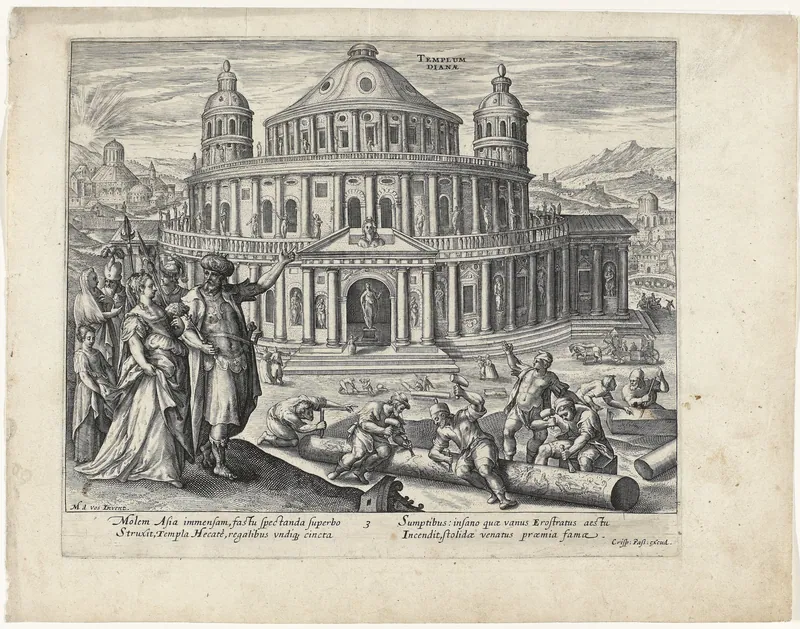
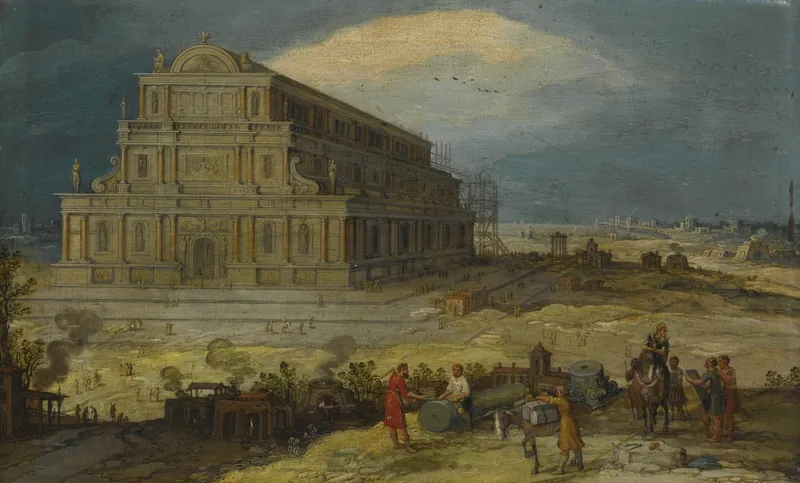
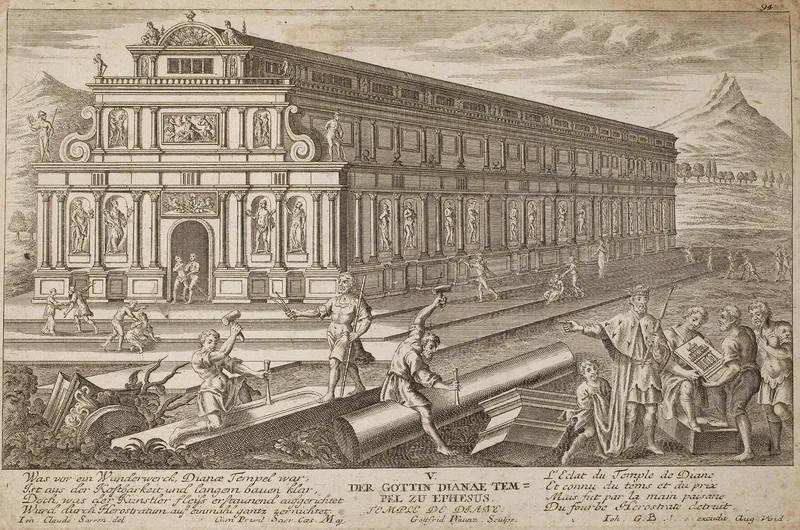
Rebuilding and Alexander's offer
Strabo (14.1.22) writes that after the fire the Ephesians built "a better one", and notes that the cost was met by collecting women's jewellery and the townspeople's own property and by selling the columns of the old temple. In 14.1.23, citing Artemidorus, he writes that Alexander offered to bear "all past and future expenses" in return for having his name on the inscription, and that the Ephesians refused; the same passage records an Ephesian telling the king that it was not fitting for a god to make dedications to other gods. The World History Encyclopedia puts the offer in 334 BC; Wikipedia writes that construction of the new temple began in 323 BC.
The dimensions of the Hellenistic temple also differ between sources: based on the excavations, the World History Encyclopedia gives about 105 × 55 m with columns 17.65 m high, while Wikipedia gives 137 × 69 m and a height of 18 m. The building was rebuilt on the same spot.
The end
Sources give dates between 262 and 268 for the Gothic raid into the Aegean: the World History Encyclopedia writes that the Goths plundered the temple about AD 267; Wikipedia gives 262 (also mentioning 268, based on Jordanes) and notes that the extent of the damage is unknown. According to the same sources, the temple was closed in the late Roman period during pressures on pagan worship. After the decree of Theodosius I in 393 banning pagan worship, according to the World History Encyclopedia, a Christian mob destroyed the temple in AD 401. Wikipedia, on the other hand, notes that there is little evidence supporting the tradition that attributes the destruction to John Chrysostom.
Rediscovery
John Turtle Wood's British Museum-backed team found the site in 1869 after a search lasting six years; the excavations continued until 1874. Before the First World War David George Hogarth excavated at the site and seemed to identify three successive temple buildings. The British Museum holds a sculpted column drum with a relief showing Hades, Persephone and Hermes. In 2015 the site was inscribed on the UNESCO World Heritage List as part of Ephesus.
What to see
The single column
The emblem of the site is the single column reassembled from fragments. Today only the foundations, fragments and this column remain on the site. In the photographs a stork's nest can be seen on top of the column, with the İsa Bey Mosque and the castle behind.
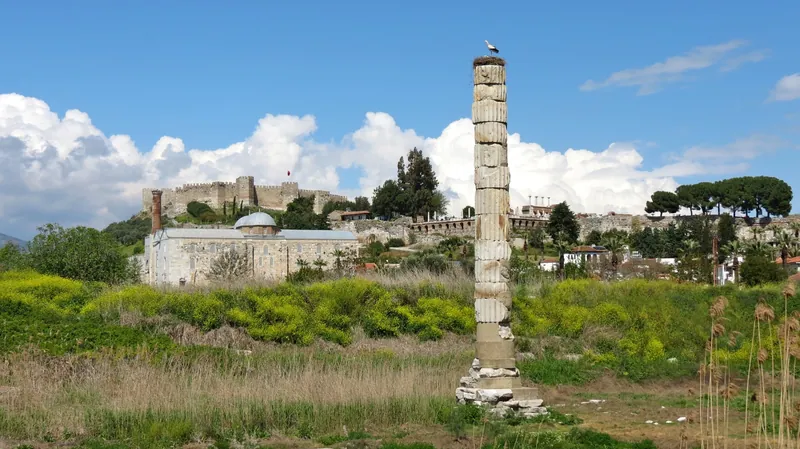
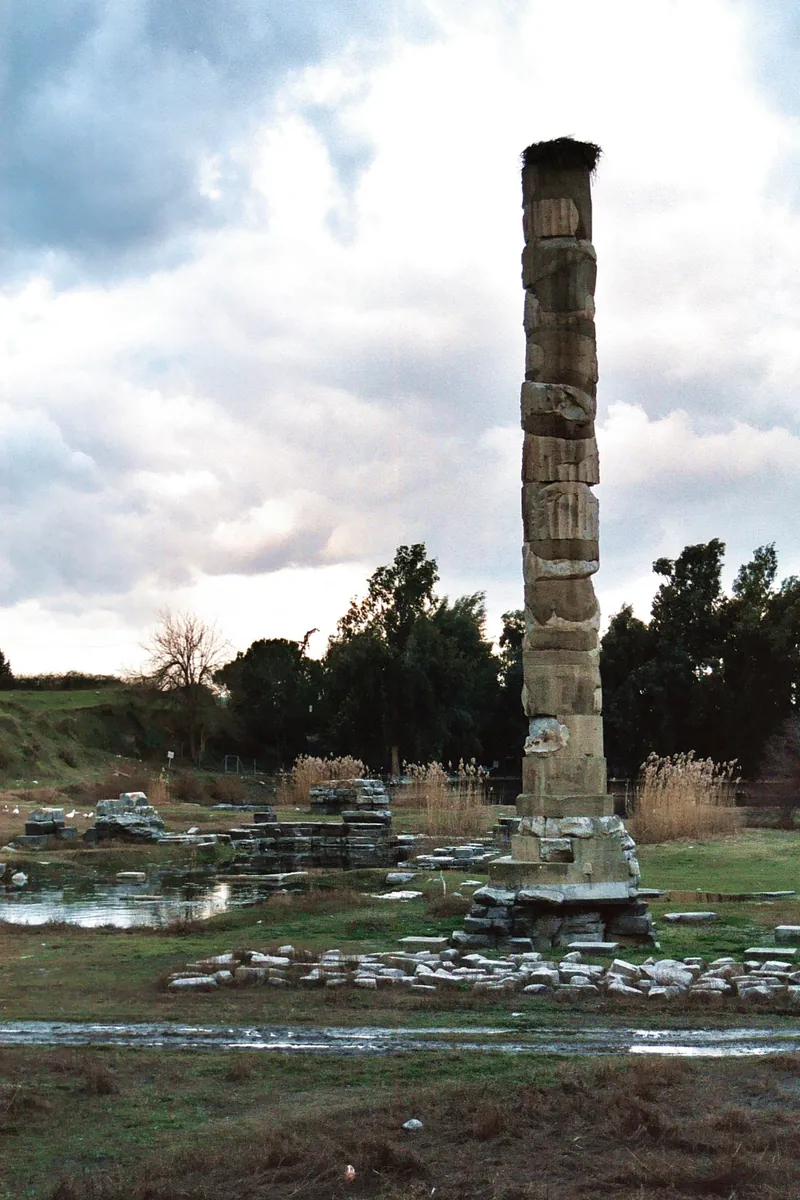
The foundations and the waterlogged ground
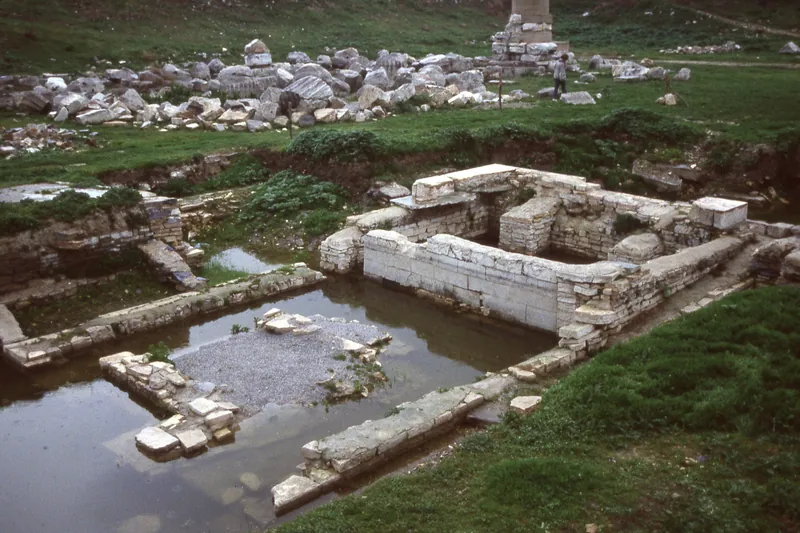
The marshy ground of the temple can still be seen today. In a photograph from 1991, the column is visible behind a foundation filled with water and the remains of an altar.
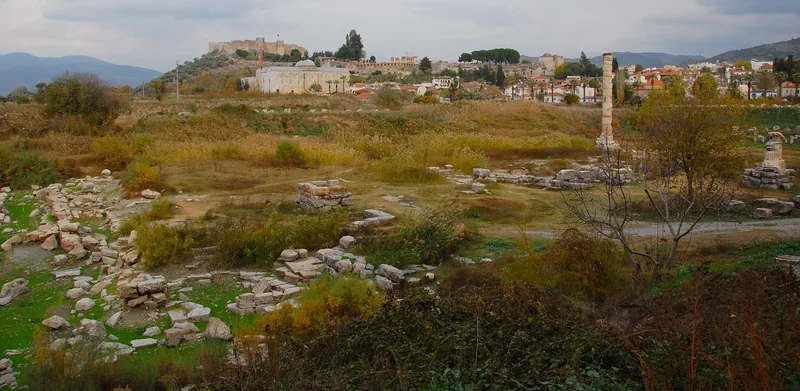
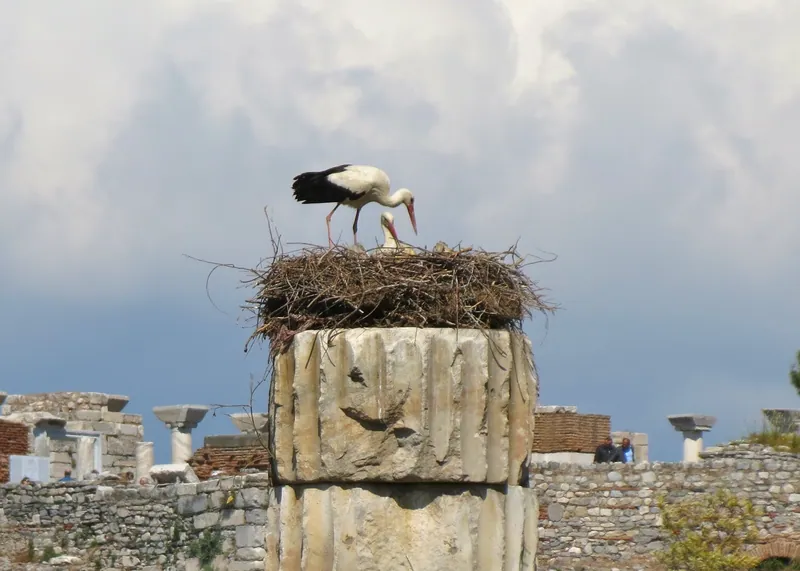
On the route
The Temple of Artemis is the fourth story on the Aegean Coast route. The previous stop is Şirince and the next is Ephesus. After that the route continues to the House of the Virgin Mary.
Frequently asked questions
Why is the Temple of Artemis famous?
It was counted among the Seven Wonders of the Ancient World. Antipater of Sidon calls it "the house of Artemis rising to the clouds". In the Pliny translation quoted by the World History Encyclopedia, it is called "the most wonderful monument of Greek magnificence".
Who burned the temple?
According to the traditional account, Herostratus, on 21 July 356 BC. Herostratus is said to have confessed that he wanted to be famous, and his name was forbidden to be spoken; modern scholars, however, question this account.
Why did the Ephesians refuse Alexander's offer?
According to Strabo, Alexander offered to bear the whole cost and asked for his name on the inscription; the Ephesians refused. Strabo reports that an Ephesian told the king that it was not fitting for a god to make dedications to other gods.
What is left of the temple today?
Foundations, scattered fragments and a single reassembled column. The British Museum displays a sculpted column drum and other pieces from the temple.
Sources
- World History Encyclopedia: Temple of Artemis at Ephesus
- Wikipedia: Temple of Artemis
- Wikipedia: Herostratus
- Strabo, Geography 14.1.22–23 (Thayer, University of Chicago)
- M. Kerschner, The Artemision of Ephesos, Ancient World Seminar abstract, University of Groningen, 2022
- Kraft et al., The geographies of ancient Ephesus and the Artemision in Anatolia, Geoarchaeology 22(1), 2007