House of the Virgin Mary: A Shrine Found Through a Vision
House of the Virgin Mary near Ephesus: Emmerich's visions, the 1891 discovery, three papal visits and the Church's reluctance to rule on authenticity.
The House of the Virgin Mary is a small stone building on the slope of Bülbül Dağı (Nightingale Mountain) near Ephesus. It is about 7 km from Selçuk; the Catholic Church visits it as a house where Mary is believed to have spent her last years, but has not ruled on its authenticity. Muslims as well as Christians visit it.
The story of the house begins in an unusual way: a bedridden nun in Germany described in her visions a house near Ephesus; years later this description brought two Lazarist priests from İzmir to this mountain (the first identification had been made in 1881 by another priest). This article sets out how the sources tell that chain of events, who says what, and what remains without proof.
At a glance
- Location: Bülbül Dağı (ancient Koressos), about 7 km from Selçuk according to Wikipedia and Yeni Asır (Küre Ansiklopedisi gives 12 km).
- Discovery: July 1891 by Lazarist priests (according to Wikipedia, Poulin and Jung on 29 July); the French priest Julien Gouyet had in 1881 identified a building as the house described by Emmerich.
- Popes: Paul VI (26 July 1967), John Paul II (30 November 1979), Benedict XVI (29 November 2006).
- The Church's position: It has never officially declared the house authentic.
- Also: The Council of Ephesus in 431 gave Mary the title "Theotokos".
History
A nun's visions
Anne Catherine Emmerich (1774–1824) was a bedridden Augustinian nun in Dülmen, Germany. She said that in her visions she saw details of Mary's life and of a house in Ephesus. The poet Clemens Brentano stayed in Dülmen for five years and noted down these accounts; the book compiled from Brentano's records was published in Munich in 1852, after Emmerich's death. Emmerich was beatified by John Paul II on 3 October 2004. When the beatification file was submitted in 1892, an examination of Brentano's documents showed that there were apocryphal gospel sources, maps and travel guides that may have enriched the accounts.
1881 and 1891: the house is found
On 18 October 1881 the French priest Julien Gouyet identified a small stone building on the mountain as the house described by Emmerich, but most people did not take this seriously. On 29 July 1891 the Lazarist missionaries Father Poulin and Father Jung, who had come from İzmir, found the building again; Sister Marie de Mandat-Grancey had encouraged them. The ruin, with four walls and no roof, had long been called "Panaya Kapulu" ("the Virgin's door") by the villagers of Şirince in the region, who made pilgrimages to it. Pilgrims gather at the site on 15 August, when the Assumption of Mary is celebrated.
Yeni Asır's 2019 report gives the details somewhat differently: according to the report, Father Poulin, a Lazarist priest and the director of the French College in İzmir, unable to go himself, sent two priests and two Catholic laymen to Ephesus; the group set out on 27 July 1891 and, after being misdirected to Değirmendere and Çamlık, found a ruined house on a plateau where tobacco was grown. The same report writes that the first Mass and visit took place on 20 May 1896 (with 600 people) and that in 1898 the Lazarist priests planted olive trees along the road. According to Küre Ansiklopedisi, the house the priests found and the 919 decares of land around it were purchased and registered in the Kuşadası land registry in the name of the French Lazarist superior M. Joseph B. Gabriel. The origin of the house is also disputed: according to some it belonged to the first Christian community in the region, according to others it is one of the buildings put up in Mary's name after the Council of Ephesus in 431.
Sister Marie was responsible for the purchase, repair and protection of the site from 1891 until her death in 1915; today the site is restored and protected by the American Ephesus Society (George B. Quatman Foundation), which has existed without interruption since 1955.
The attitude of the Church authorities also developed step by step: Pope Leo XIII blessed the first pilgrimage in 1896 and took a favourable stance, Pius XII declared the house a "Holy Place" in 1951, and John XXIII made this privilege permanent. The Church has never officially declared its authenticity; the reason given is the lack of sufficient scientific evidence. The date of the "Holy Place" declaration does not agree across sources: Wikipedia gives 1951, while Küre Ansiklopedisi writes that Paul VI declared it an "official holy pilgrimage place" during his visit in 1967.
The dispute: Ephesus or Jerusalem?
It is said that the tradition placing Mary's "departure" at Ephesus dates from the 12th century, while the Jerusalem tradition is older. Sceptics note that the Ephesus link appeared only in the 12th century and that older church writers said Mary spent her last years in Jerusalem; supporters point to the 5th-century Church of Mary at Ephesus. The link based on John 19:18–30 does not strongly prove that Mary lived there.
431: Theotokos
Ephesus's real connection with Mary rests on another event. The Council of Ephesus, convened by Emperor Theodosius II, met in the Church of Mary at Ephesus from 22 June to 31 July 431. The council gave Mary the title "Theotokos" (bearer of God); Nestorius, the Patriarch of Constantinople, rejected this title and preferred to say "Christotokos" (bearer of Christ); the council judged his teaching heretical and removed him from office.
Three popes
Pope Paul VI visited the house on 26 July 1967; John Paul II on 30 November 1979; Benedict XVI on 29 November 2006, during a four-day visit to Turkey. According to EWTN, Paul VI arrived in Turkey on 25 July 1967; after İzmir he visited Mary's house at Ephesus. The same report calls the journey the first papal visit to Istanbul since the one made when the city was still called Constantinople.
Christianity and Islam
Mary is a respected figure for Muslims too. She is the only woman named in the Quran; the 19th surah (Surah Maryam) bears her name. The house is also visited with respect by Muslims. According to Yeni Asır, the Quranic verses about Mary were placed on the site in 1985–1986 at the request of the governor of İzmir, to reflect the respect Muslims have for her.
What to see
The house and the dividing line
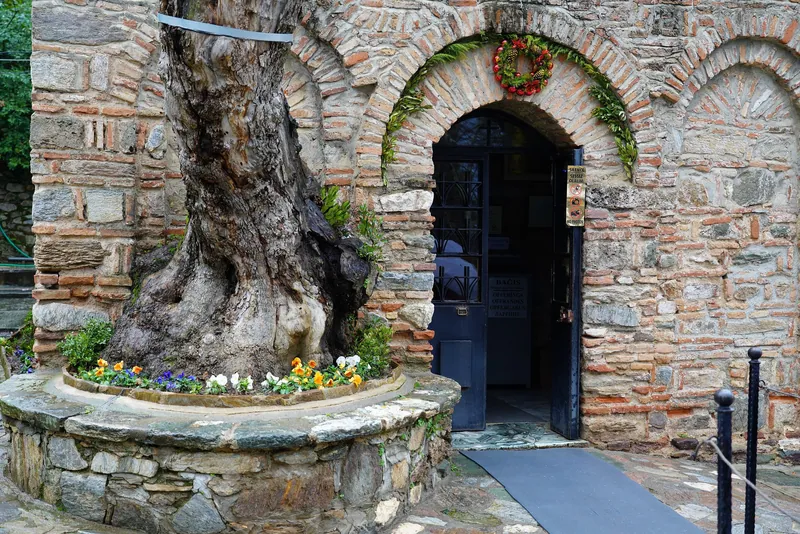
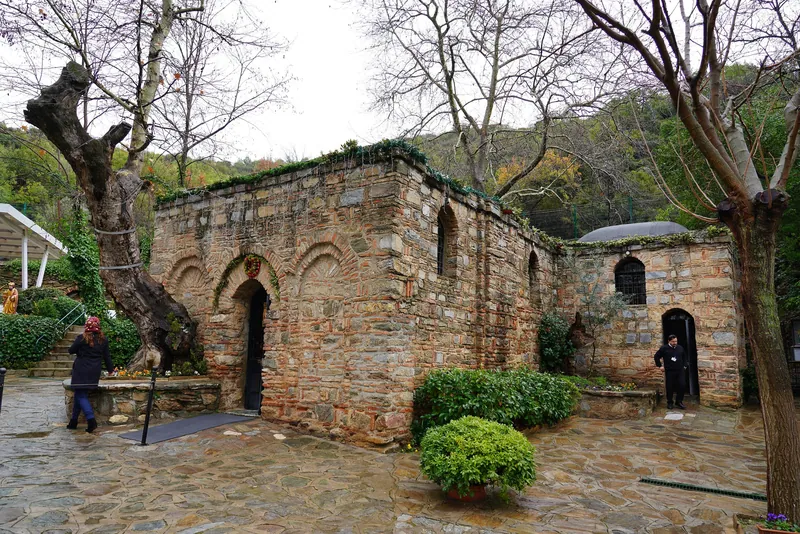
The small stone building is used today as a chapel. The restored part is separated from the original remains by a red paint line. So visitors can see with their own eyes which part is old and which was added later.
Water and the wishing wall
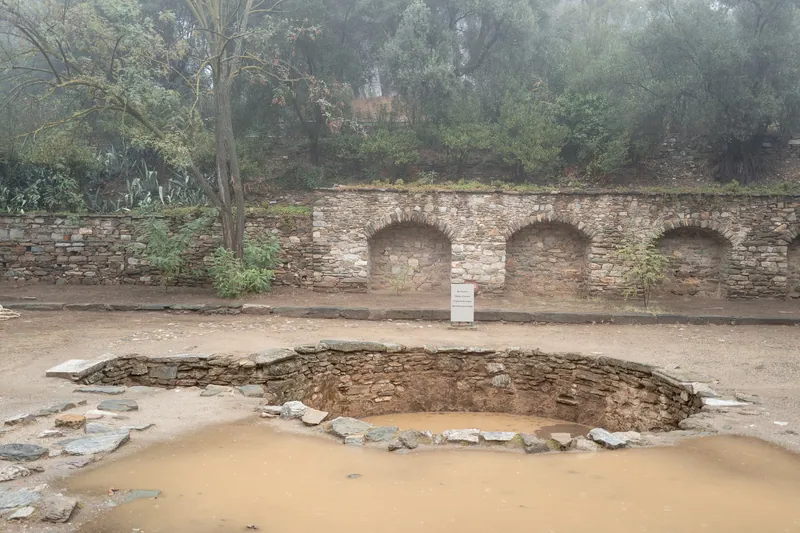
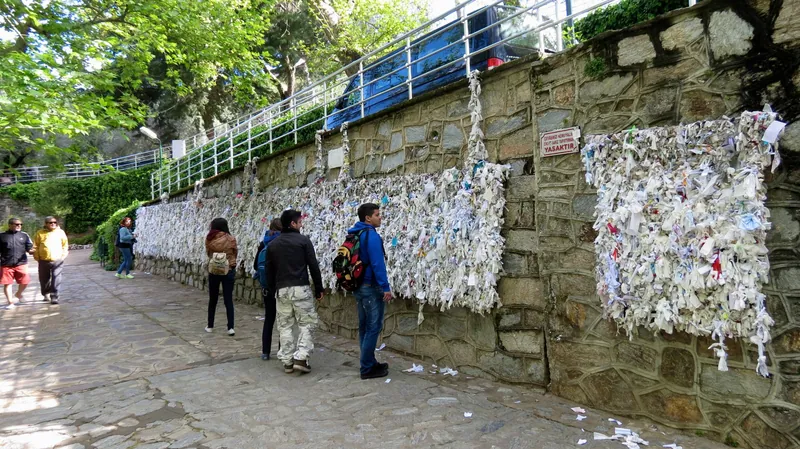
Near the house there is a water cistern (labelled "Su Sarnıcı" on the sign) and an arched wall where springs come. Tradition holds that water once flowing from the small room where Mary rested continues to today's drinking fountain; there is also a wishing wall where visitors write and tie their wishes.
Statue and Mass
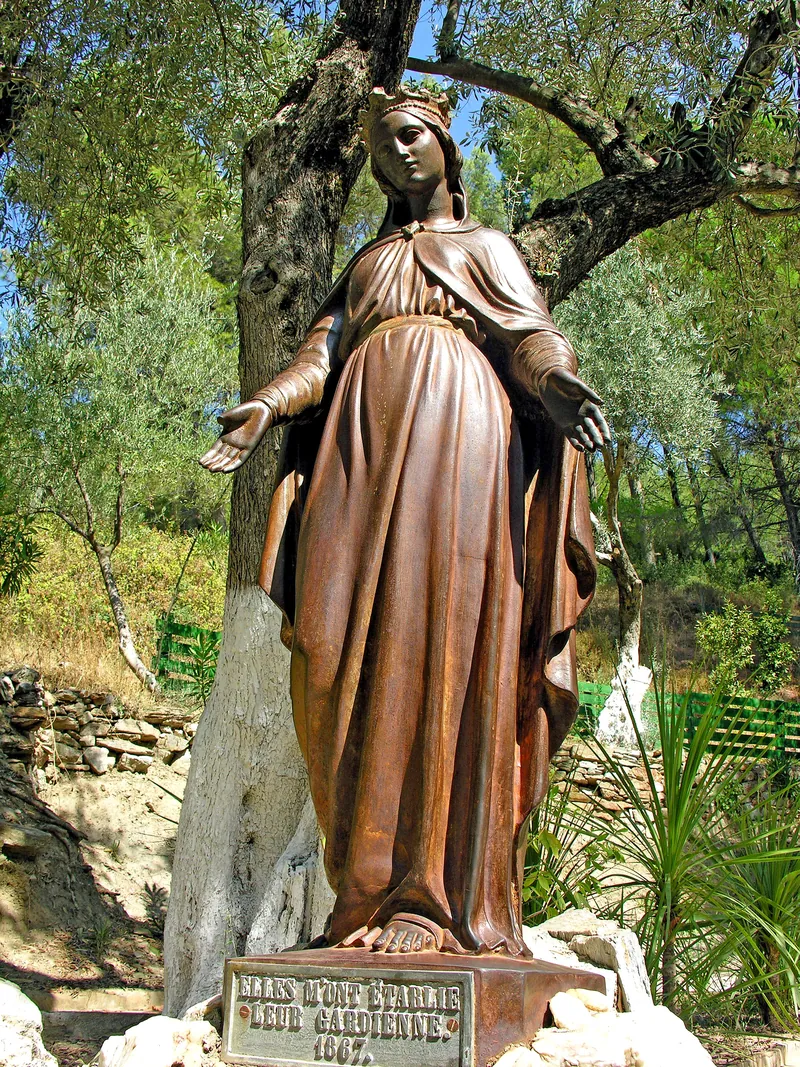
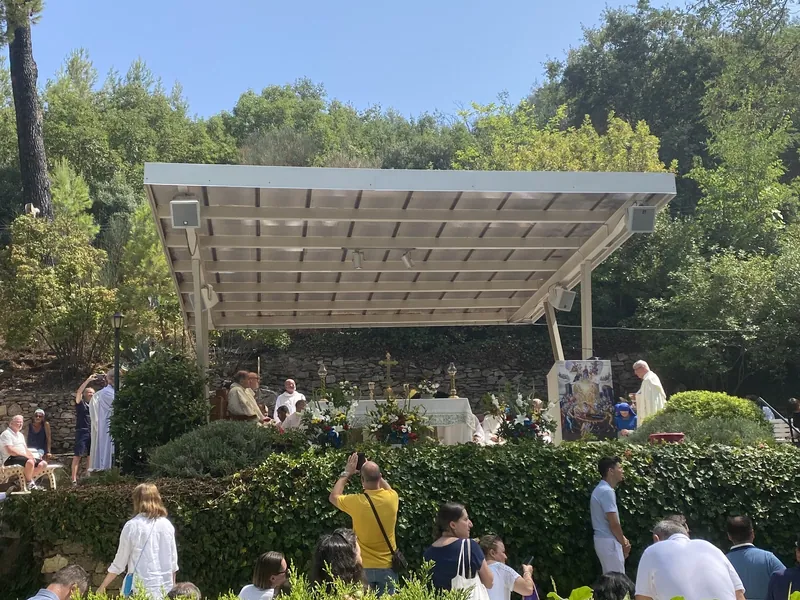
There is a bronze statue of Mary on the site; a French inscription and the date 1867 can be read on its pedestal. An open-air Mass is held near the house on 15 August; a photograph from 2023 shows it.
On the route
The House of the Virgin Mary is the sixth story on the Aegean Coast route. The previous stop is Ephesus and the next is Pigeon Island. After that come Priene, Miletus and Didyma.
Frequently asked questions
Is the House of the Virgin Mary really Mary's house?
It is not known for certain. The Catholic Church has never officially declared its authenticity. Critics say the Ephesus tradition appeared in the 12th century; supporters point to the 5th-century Church of Mary at Ephesus.
How was the house found?
On the basis of the visions of Anne Catherine Emmerich, a bedridden nun in Germany. These accounts were written down by Brentano and published in 1852. Julien Gouyet identified the building in 1881 and Lazarist priests in 1891 (according to Wikipedia on 29 July); the details vary with the sources.
What did the Council of Ephesus do for Mary?
The council, which met in 431, gave Mary the title "Theotokos" and condemned the teaching of Nestorius.
Have popes come here?
Yes: Paul VI (26 July 1967), John Paul II (30 November 1979) and Benedict XVI (29 November 2006).
Do Muslims visit it?
Yes, Muslims also visit the house with respect. Mary is the only woman named in the Quran, and the 19th surah bears her name.
Sources
- Wikipedia: House of the Virgin Mary
- Wikipedia (Turkish): Meryem Ana Evi
- Wikipedia: Council of Ephesus
- Wikipedia: Mary in Islam
- Yeni Asır: Rüyayla keşfedilen kutsal ev (2019) (Turkish newspaper; The holy house discovered through a dream)
- Küre Ansiklopedisi: Bülbüldağı (Turkish encyclopaedia; Bülbüldağı)
- EWTN News: Remembering Pope Paul VI's historic visit to Turkey