Miletus Ancient City: Home of Thales, a Port Left Inland
Miletus ancient city in Didim: home of Thales and Anaximander, the sack of 494 BC, the grid plan, the theatre and a harbour left inland by silt.
The ancient city of Miletus lies in the Didim district of Aydın, near the village of Balat, on the plain at the mouth of the Büyük Menderes (the Great Menderes, the ancient Meander). In antiquity it was a port on the coast, at the southern entrance of a broad gulf; today the ruins lie about ten kilometres inland. It has a place in the history of philosophy as the city of Thales, Anaximander and Anaximenes, and in the memory of the Greek world for its sack by the Persians in 494 BC.
The story of the city is the story of trade, colonies and the silt brought by the river. This article explains why Miletus is considered so important, on which numbers the sources diverge, and what can be seen there today.
At a glance
- Location: Didim, Aydın; the ruins are about 10 km from the sea, because the silt of the Menderes filled the harbour.
- Harbours: Turkish Wikipedia mentions four harbours of the city.
- Thinkers: Thales, Anaximander, Anaximenes.
- Colonies: Sources give numbers ranging from 75 to 98.
- 494 BC: After the naval battle of Lade, the Persians sacked the city.
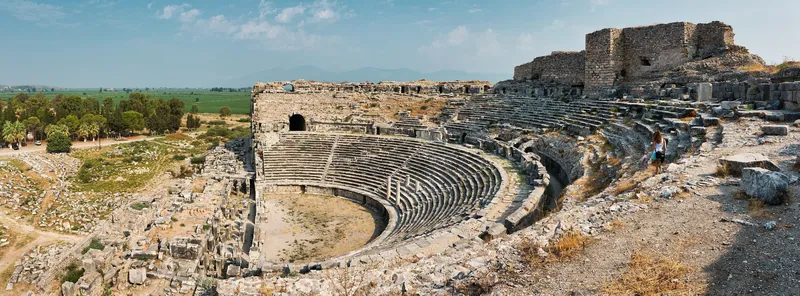
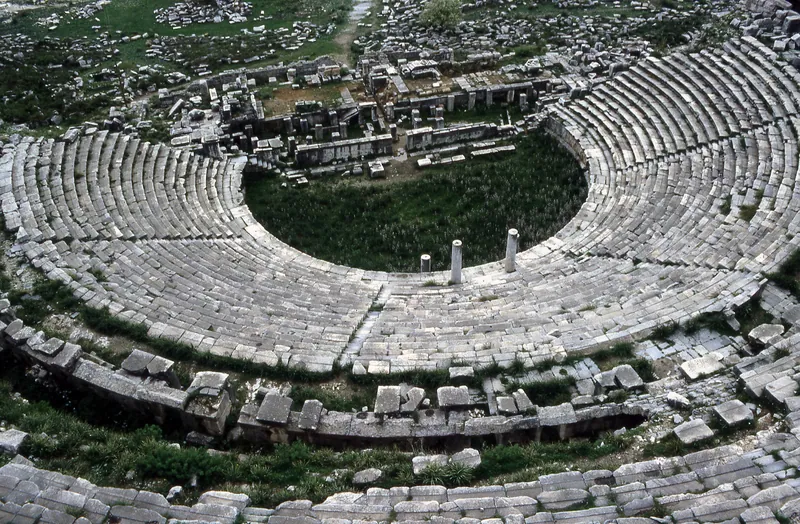
- Theatre: For about 15,000 people.
- Neighbour: It was linked to Didyma in the south by the Sacred Way (the length of the road is about 18–20 km, depending on the source).
History
The Bronze Age: Millawanda
Hittite records mention Miletus as Millawanda. According to Livius, three phases were identified in the excavations near the Temple of Athena: a Minoan settlement; a Mycenaean city founded in the second half of the 15th century and destroyed around the turn of the 14th century (perhaps by Mursili II); and a walled Late Mycenaean city that flourished in the 13th century and was destroyed in the second half of the 12th century. Wikipedia places Mycenaean dominance at about 1450–1100 BC and also mentions that Homer counts Miletus as an ally of Troy. According to Herodotus the city was founded by the Athenian Neileus (Livius); the Turkish Wikipedia gives the same name as Neleus and describes him as the son of Codrus.
Colonies and thinkers
Miletus was one of the twelve Ionian cities. In the 7th–6th century a "colonisation alliance" with Megara is mentioned; under the tyrant Thrasybulus the city kept its independence in a war against Lydia that lasted 12 years. The number of colonies varies from source to source: Livius writes that Seneca mentions about 75 colonies (such as Abydos, Sinope and Naucratis in Egypt); Wikipedia records that Pliny said more than 90 (marked "citation needed"); the Turkish Wikipedia says 98. Sinope, Olbia and Panticapaeum on the Black Sea coast are counted among the Milesian colonies.
Thales lived about 626/623–548/545 BC. According to Aristotle's Metaphysics, Thales regarded water as the first principle of nature. Herodotus (I.74) writes that Thales predicted a solar eclipse that interrupted a war between the Lydians and the Medes, and dates the eclipse to 585 BC; but there are serious doubts about the historicity of this story. Anaximander (about 610–546 BC) proposed the apeiron, meaning "the unlimited", as the origin of everything. Strabo and Agathemerus, relying on Eratosthenes, count him as the first person to publish a map of the world; Censorinus (3rd century AD) reports that he thought humans developed inside fish-like creatures. These are late and indirect reports; only a single fragment of Anaximander has survived. Livius adds that Hecataeus is regarded as the founder of geography.
499–494 BC: the Ionian Revolt
In 499 BC Aristagoras started the Ionian Revolt; in 494 Darius's forces put it down at the naval battle of Lade. The city was sacked: the men were killed, the women and children were enslaved, and the young men were castrated and deported. Many people were sent into exile.
There is a record that shows the echo of the destruction in the Greek world. According to Herodotus (VI.21, Rawlinson translation), when the poet Phrynichus staged his play "The Fall of Miletus", "the whole theatre burst into tears"; the Athenians fined him a thousand drachmas for reminding them of their own disaster and forbade the play to be performed again.
Rebuilding on a grid plan
Livius and Wikipedia write that after the destruction the city was rebuilt on a grid plan; Wikipedia ties the plan to Hippodamus, but as explained in the Priene article this naming is disputed. The Greeks liberated the city after their victory at Plataea in 479 BC. Archaeologically, a grid street system has also been confirmed for the Archaic period. That Hippodamus was from Miletus is stated in Livius.
The Classical and Hellenistic periods
After the Persian Wars Miletus joined the Delian League and paid ten talents of silver; in the 440s BC it tried to leave the league, was defeated and received an Athenian garrison. Aspasia was the Milesian woman who married Pericles. The building of the theatre, which still dominates the site today, began in the 4th century under Hecatomnus, satrap of Caria. Alexander the Great took Miletus in 334 BC after a short siege; from then on the city gained more autonomy than it had seen for at least two centuries. At its greatest extent it covered about 90 hectares inside its walls.
Rome, Byzantium and abandonment
After an alliance with Rome, Miletus was added to the province of Asia in 133 BC; most of the monuments seen today belong to this period. According to Livius, only Ephesus was a more important city in Anatolia. According to the New Testament, Paul met the elders of Ephesus here around AD 57. New walls were built in 262; by the time Justinian I repaired the walls in 538 the city had shrunk to a small town. The harbour continued to silt up. The Turks took the city at the end of the 13th century; Byzantium briefly took it back in 1294/5. The Ottomans used the city as a port in the 14th–15th centuries; in the end the silt made it abandoned.
The silting-up of the harbour began about 1000 BC, and by AD 300 Lake Bafa had formed. Today the distance to the coast is about 10 km.
Excavations
The first excavation was carried out by Olivier Rayet in 1873; Julius Hülsen and Theodor Wiegand worked in 1899–1931. Carl Weickart excavated in 1938 and in 1955–57, followed by Gerhard Kleiner and Wolfgang Müller-Wiener; the excavations are today run by Ruhr University Bochum. The Market Gate is in the Pergamon Museum in Berlin; the Miletus Museum in Didim houses the main collection. The sources differ on the year the museum opened: the English Wikipedia says 1973, the Turkish Wikipedia 1963.
What to see
The theatre
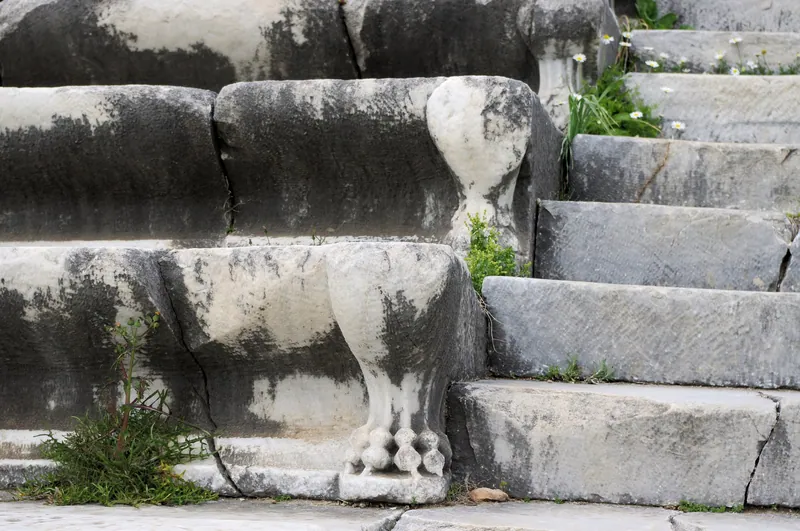
The theatre holds about 15,000 people; it was built in the 4th century BC, enlarged in the Hellenistic period, and took its present form in the Roman period. There are lion-paw decorations on the seating. Turkish Wikipedia writes that the city's four harbours could be seen from the upper tiers of the theatre.
The harbour, the Delphinion and the surroundings
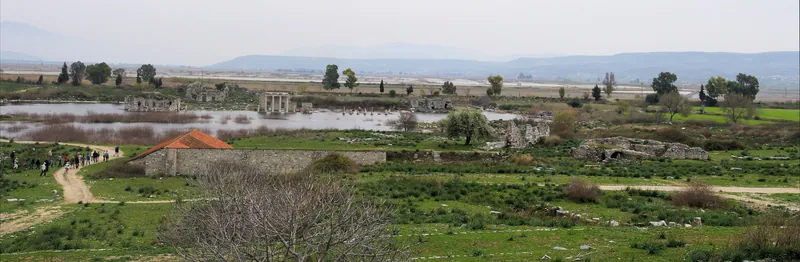
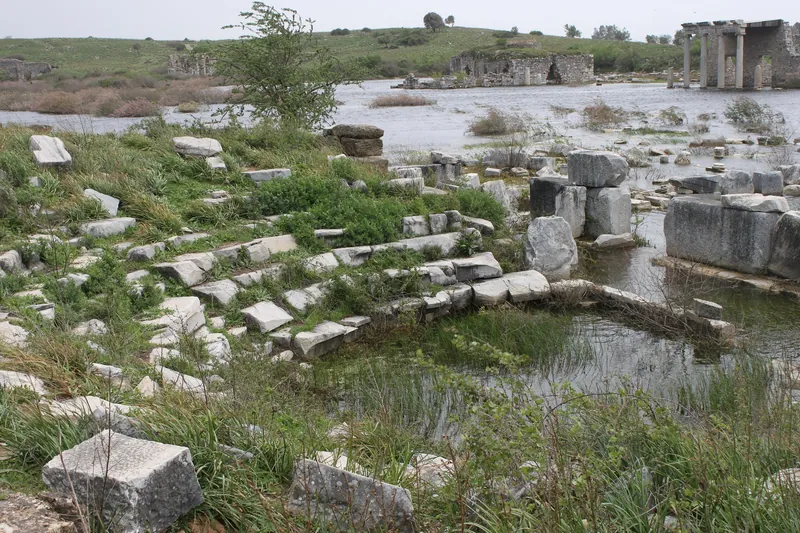
The Delphinion by the Lion Harbour dates from the 6th century BC; it was destroyed in 494 BC, rebuilt, and measured about 60 × 50 m. Today flooded areas and standing columns can be seen on the plain.
Roman structures
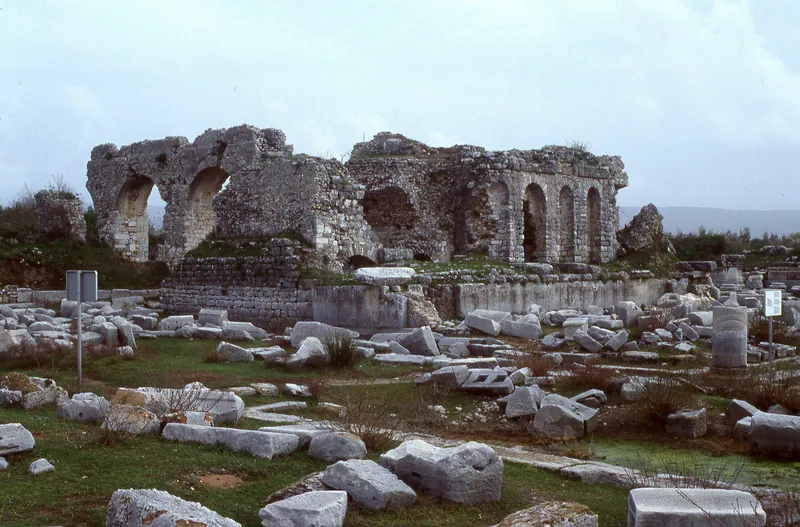
The Baths of Faustina were built in 161–180 with money given by Faustina, wife of Marcus Aurelius; the bouleuterion (the city council building) held 1,500 people.
The İlyas Bey Complex
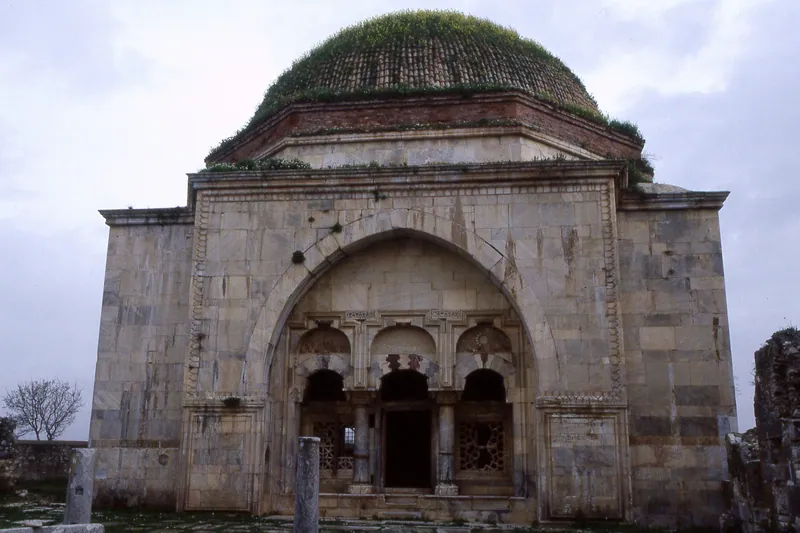
The complex built by İlyas Bey, ruler of the Menteşe beylik, is dated 1403 according to the English Wikipedia; the Turkish Wikipedia gives two different years, 1404 and 1494, so the date varies with the source. The mosque, with a single dome and a single minaret, is known for its marble decoration (Turkish Wikipedia).
On the route
Miletus is the tenth story on the Aegean Coast route. The previous stop is Priene and the next and last stop is Didyma. Ephesus, another port of the route, was also choked by silt like Miletus.
Frequently asked questions
How many colonies did Miletus have?
There is no exact number. Livius writes that Seneca mentions about 75 colonies; Wikipedia that Pliny said more than 90; the Turkish Wikipedia says 98.
Why was Phrynichus's play banned?
According to Herodotus (VI.21), "The Fall of Miletus" moved the theatre to tears; the Athenians fined the poet 1,000 drachmas for reminding them of their own disaster and forbade the play to be performed again.
Did Thales really predict the solar eclipse?
Herodotus (I.74) writes so and dates it to 585 BC. There are serious doubts about the historicity of this story.
Why is Miletus far from the sea today?
The silt carried by the Büyük Menderes filled the harbour and the gulf. The filling began about 1000 BC, and the ruins are today about 10 km inland.
What was Miletus's connection with Didyma?
The Sanctuary of Apollo at Didyma lies about 16 km to the south in a straight line and was linked to Miletus by the Sacred Way; Wikipedia's article on Miletus gives the length of the road as about 18 km, its article on Didyma as about 20 km.
Sources
- Wikipedia (English): Miletus
- Wikipedia (Turkish): Milet
- Livius.org: Miletus
- Wikipedia: Thales of Miletus
- Wikipedia: Anaximander
- Wikipedia: Phrynichus (tragic poet)
- Herodotus, Histories VI (Rawlinson translation, MIT Classics)